

Cutting Red Tape With Innovation
What’s Causing Lengthy Permit Reviews—and What Does It Mean for Buyers and Renters Over Time?
Words by Chris Quigley | Director of Development
What’s Causing Lengthy Permit Reviews—and What Does It Mean for Buyers and Renters Over Time?
Words by Chris Quigley | Director of Development
Feb 17, 2026 · 6 min read

Rarely has a government come to power in the last 50 years without boldly claiming it would speed up permitting and reduce inefficiencies in the planning system. This is not just a Canadian experience—most countries around the world seeking to grow their economies and increase their citizens’ quality of life consistently point a finger at slow and punitive planning. Mark Carney recently proposed a Liberal housing plan to “cut red tape” and “reduce housing bureaucracy.” Similarly, since being reelected in 2024, the BC NDP has set the goal of BC being “a North American leader in digital permitting and construction.”
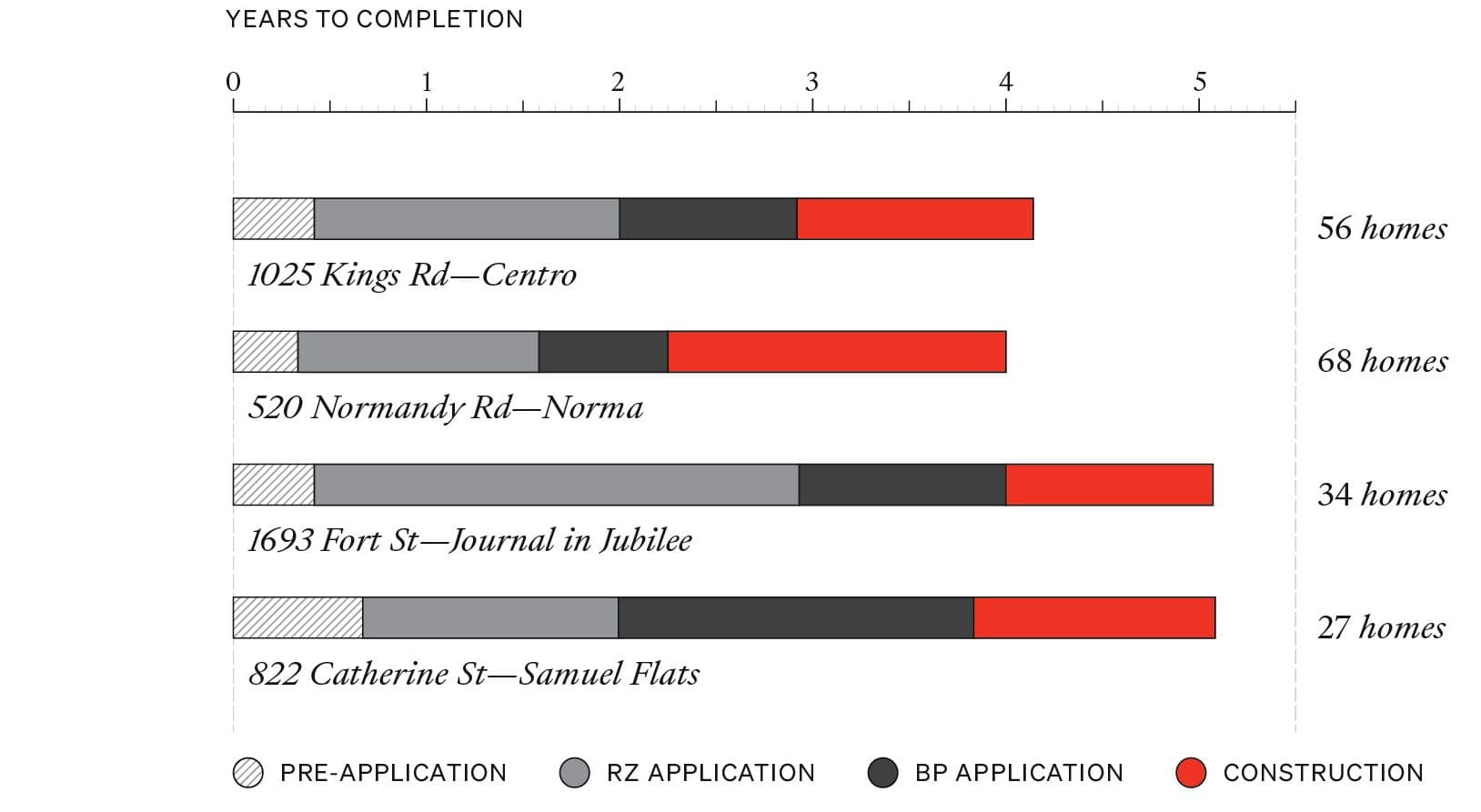
At Aryze, we see every day how long approval timelines drive up the cost of building—and ultimately, the price of new homes. The bar graph below shows recent examples of multi-family rental projects that required rezoning. In many cases, up to 70% of the total project timeline is spent “on paper”—before any construction begins on site.
This is not to devalue the work of municipal planning staff. There are many instances where lengthy reviews from staff and elected officials have resulted in significantly improved projects. Municipal planners have an important role in safeguarding the public interest and weighing trade-offs when community change is proposed. However, most would agree (and clearly politicians are getting elected on this premise) that the planning checks and balances can become a byzantine system. Before jumping to solutions, it is important to understand why permitting can take such a long time.
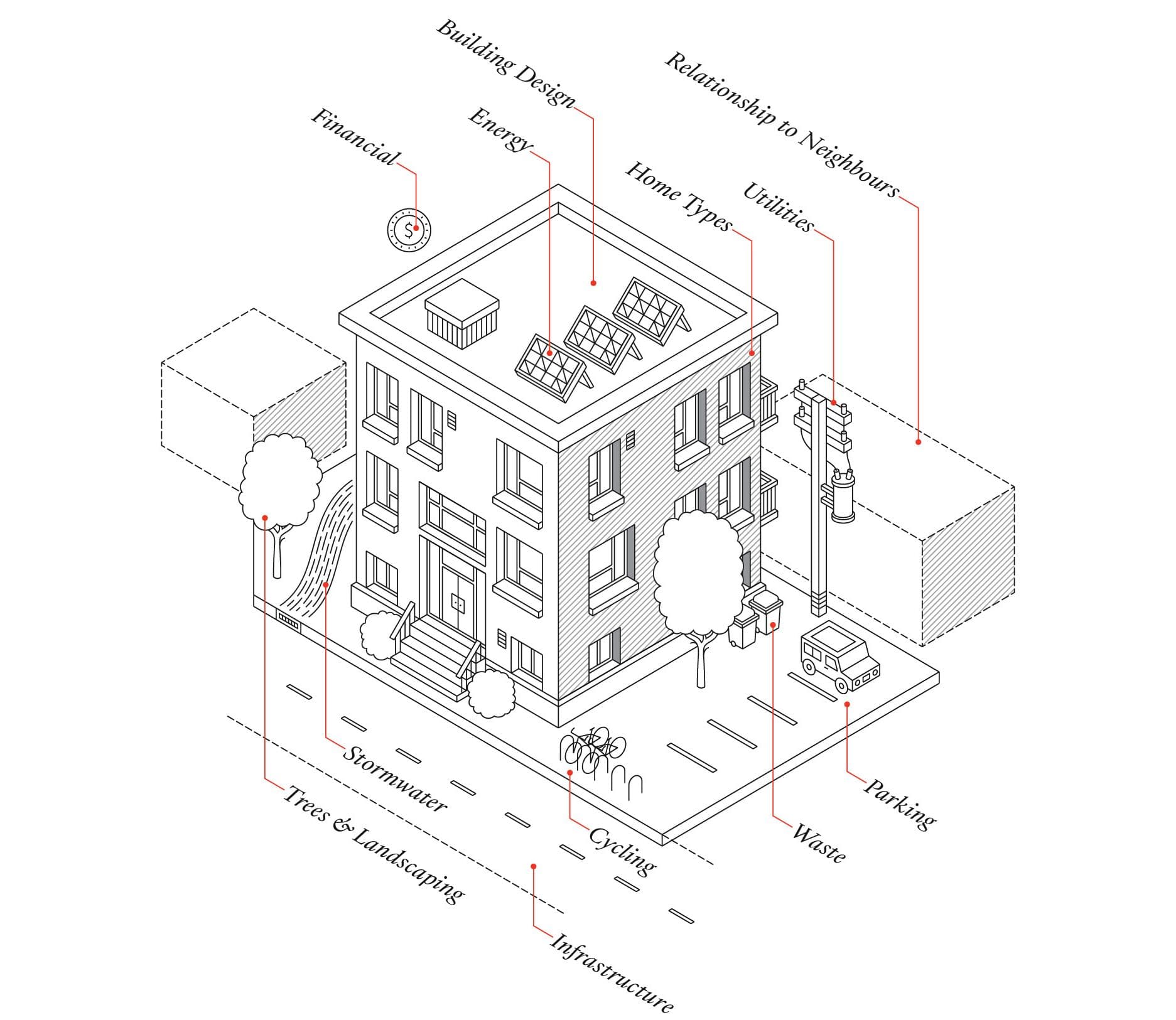
1. Most people don’t realize just how many layers are involved in a city’s technical review process.
The graphic below highlights the wide range of topics that are typically analyzed and evaluated during a project review.
2. Applicants often change projects over time.
This is not a bad thing; in many cases, it shows flexibility in responding to feedback. Changes may also occur as a result of rising costs or shifts in market conditions. For example, in recent years, the province has seen some housing projects switch from condo to rental. Often, these changes may trigger new staff reviews, which can add time.
3. Nobody is perfect.
Applicants often submit incomplete information in their applications, which can lead to misunderstandings or an inability to provide comprehensive technical reviews.
4. Finally, it’s worth reflecting on how new construction in 2025 is required to achieve a lofty set of goals.
As public policy grows in sophistication, it places an ever greater demand on new projects. Many of the buildings we admire in our cities are from previous years or generations and were never required to meet the scale of policies that municipalities now apply to new projects. Individually, these policies may be very laudable, but taken together they can become overwhelming and, again, add time to the permitting process.
Throughout 2025, we continued construction on Wisteria Row—an 18-unit townhome project in the Gonzales neighbourhood. It’s also become a clear case study in how long rezoning timelines can affect a project’s original vision.
When we first submitted the proposal in 2019, the plan included a partnership with BC Housing to offer all homes at affordable ownership rates. By the time we returned to Council in 2022—three years later—market conditions had shifted significantly. That change meant we had to revisit and amend the affordability framework, which was not the outcome we’d originally set out to achieve.
It’s a real-world example of how external economic forces—combined with lengthy review periods—can challenge project viability, even with the best intentions and public benefit in mind.
Carla Matheson, Aryze’s Director of Finance, continues to see firsthand how the length of the pre-construction period has direct impacts on a project’s viability.
“At Wisteria Row (907–909 Redfern), delays meant years of carrying land costs, managing rising interest rates and significant construction inflation. All of these factors compound over time,” says Carla. “In this project we saw a 5.7% increase in interest rates on construction financing. This factor alone can shift a project from feasible to marginal—or even unviable—in the eyes of lenders. Every additional month introduces more uncertainty, adds costs and impacts our ability to deliver on affordability for homeowners. The longer it takes to get shovel-ready, the harder it becomes to deliver on the original intent.”
Well-intentioned policies like amenity contributions or housing agreements need to be balanced with financial reality. We’re not choosing between affordability and profit—we’re trying to keep good projects alive in a high-risk, slow-moving system. Just like a bank won’t approve a mortgage if the numbers don’t add up, lenders can’t support projects that don’t meet a minimum return. Our shift towards market pricing wasn’t a strategic pivot—it was a necessary step to meet those thresholds and ensure the project could move forward at all.
Since 2024, the BC Ministry of Housing and Municipal Affairs has been hard at work developing the Building Permit Hub—a platform designed to streamline permitting by simplifying how information is submitted, standardizing requirements across participating municipalities and offering clear, user-friendly guidance. The goal: a process that’s “quicker, more collaborative and more consistent.” We reached out to the province to learn more.
“The Building Permit Hub is about getting more homes built, faster—homes that people in BC can afford and that meet the needs of their communities,” said Christine Boyle, Minister of Housing and Municipal Affairs. “By streamlining and standardizing permitting processes across the province, we’re helping local governments and builders save time and reduce costs. Our goal is to expand the Hub’s capabilities by the end of the year so that more people and communities can benefit from faster approvals and a more efficient way of delivering more homes for people.”
BC has 161 municipalities—and when it comes to permitting, no two seem to do it quite the same. We regularly see different processes and timelines between places like Victoria, Saanich and beyond. A more standardized approach to applications and reviews would bring major efficiencies. It’s a crucial step forward for the industry, and at Aryze, we’re eager to support the rollout of improved systems. We’re especially interested in how this work can scale to include all permit types, with the long-term goal of enabling automated reviews for many steps along the way.
Innovation is not only happening in the public sector. BUILDCHECK is a company that is embracing AI-powered design reviews to explore if design errors can be caught prior to permit submission. Drawing errors can delay projects in the permit stage, but also lead to omissions and inconsistencies that are costly during construction. Co-founder and CEO Alex Michalatos has begun partnering with many BC-based developers to screen designs before submitting for permit. This has the potential for a win-win for both the developers and the municipality.
This year, we’re very excited to be partnering with BUILDCHECK. As buildings grow more complex in response to evolving policy goals, we believe collaboration between the private and public sectors is essential to driving smarter, more informed decisions. There’s no silver bullet for housing affordability—but innovations in how we process permits can make a real difference. Faster, more efficient approvals mean we can deliver homes sooner and that benefits future renters and homeowners across our city.